Why smart building integrators outsource HMI development to an end-to-end partner
Smart building interfaces are becoming more sophisticated as lighting, HVAC, access control, room booking, shading, security and energy management systems converge within connected environments.
For integrators, that creates a growing HMI challenge.
The interface needs to present information clearly, respond quickly and fit naturally within the building. Behind the screen, it may also need embedded computing, touch integration, tactile controls, communications, software, mechanical engineering and long-term component support.
Developing all of those capabilities internally can consume considerable engineering resources that would otherwise be focused on the wider automation system.
This is one reason smart building integrators and OEMs increasingly work with specialist HMI partners. Instead of sourcing the display, touchscreen, computing platform and mechanical components separately, an end-to-end provider can develop the complete interface around the requirements of the building system.
The value is not simply outsourcing production. The right partner can help reduce integration work, identify technical risks earlier and provide a clearer route between an initial interface concept and a manufacturable product.
What is an end-to-end HMI partner?
An end-to-end HMI partner supports several stages of interface development rather than supplying an individual component.
Depending on the project, this can include display selection, PCAP touch, tactile controls, embedded computing, firmware, software integration, mechanical engineering, industrial design, prototyping, sourcing and production.
The individual technologies still need to meet their own technical requirements, but they are developed as parts of the same system.
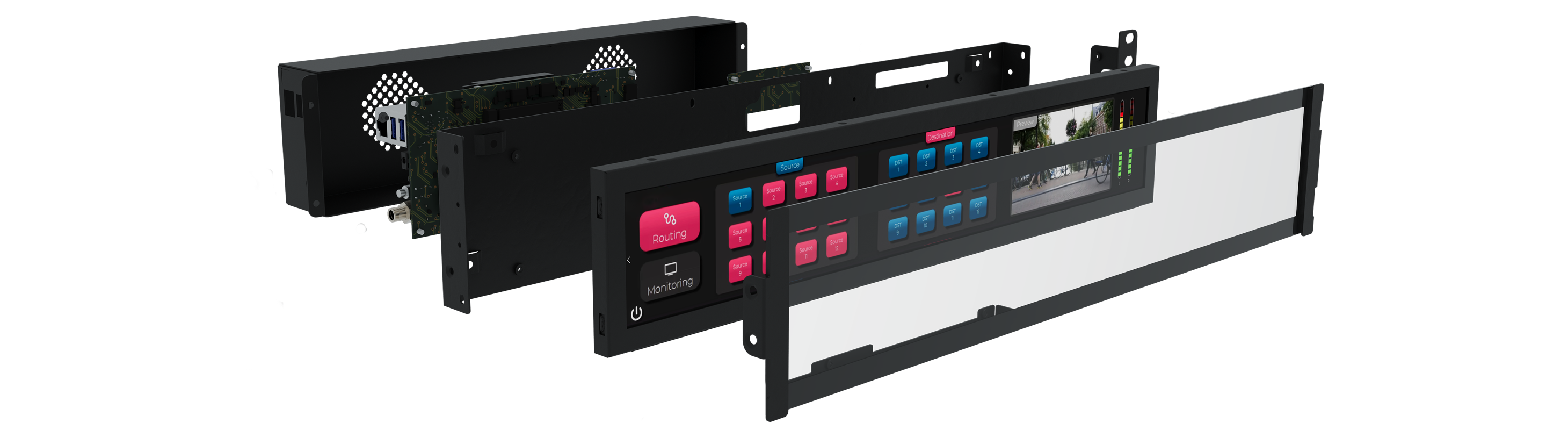
For a smart building control panel, for example, the display dimensions influence the enclosure. The touchscreen stack affects the cover glass. The selected processor influences software capability and connectivity. Tactile controls can change both the mechanical design and the UI.
Treating those decisions separately can create integration problems later.
An end-to-end development model provides a way to coordinate them earlier in the programme.
Why smart building HMI development is becoming more complex
A traditional building control interface could consist of a thermostat, keypad or dedicated switch panel.
Connected buildings increasingly require much more.
A single wall-mounted HMI may provide access to climate, lighting, room booking, access control, shading and other building systems. It may need to communicate with several platforms while maintaining a consistent interface for the user.
Industrial design requirements have increased as well.
Displays and controls are often installed in meeting rooms, offices, hotels, residential developments and other prominent locations. Integrators therefore need an interface that works technically while fitting within the architecture around it.
Densitron's smart home and workplace automation HMI technologies are designed for applications including wall-mounted control panels, smart building interfaces, room booking systems, lighting controls and access systems.
These solutions combine display, touch, tactile interaction and embedded HMI capabilities within the same development environment.
Why outsource HMI development?
Integrators usually create most value through their understanding of the building system itself.
That can include system architecture, controls, automation logic, commissioning, network integration and the relationship between technologies from different vendors.
Developing a custom HMI introduces another engineering discipline.
The project may require specialist knowledge of TFT or OLED displays, touch sensors, optical bonding, embedded processors, mechanical design, thermal performance and manufacturing.
Building every capability internally can require additional engineering staff, development tools, supplier relationships and manufacturing resources.
Outsourcing selected HMI development allows the integrator to retain control over the system architecture and user requirements while drawing on specialist engineering for the physical interface.
This can be particularly useful where the HMI is an important part of the customer experience but is not the integrator's primary area of engineering expertise.
Reducing integration work across display, touch and computing
One of the difficulties in HMI development is that a control panel is made up of interdependent technologies.
A display panel might meet the visual requirements but not fit the available enclosure. A touchscreen may need different cover glass or bonding. An embedded processor may provide the required computing performance but lack the correct physical interfaces.
These problems become harder to resolve once different components have already been selected by separate teams.
Working with a partner that provides custom display and HMI solutions allows the display, touchscreen, computing platform and mechanical design to be considered together.
This can reduce the amount of adaptation required between components and give integrators a more complete subsystem to incorporate into the wider building automation architecture.
How embedded computing changes the HMI
Modern smart building interfaces increasingly contain their own processing capability.
Embedded computing can run the graphical interface, process touch and tactile inputs and communicate with the wider automation system.
This turns the control panel into more than a screen connected to another device.
The processor specification affects graphical performance, operating system support, connectivity, thermal design and long-term availability. Its selection therefore needs to happen alongside the display and interface architecture.
Densitron provides embedded HMI development alongside its display and touch technologies, allowing processing and interface logic to be incorporated into the same system.
For integrators, this can reduce the number of separate hardware platforms that need to be brought together during development.
Building automation interfaces around the user
A technically functional HMI can still create a poor experience if the interface does not reflect how people use the building.
A meeting room controller may need immediate access to lighting, temperature and room functions. A residential wall panel may bring climate, security, shading and entertainment into the same interface. A workplace system could also need room booking and access information.
Frequently used functions need to be easy to reach, while more complex controls can sit deeper within the graphical interface.
Touchscreens provide flexibility because the available controls can change according to context.
Physical and haptic controls can provide another interaction method for functions where tactile confirmation is useful.
Densitron's Tactila® technologies can add buttons, rotary controls, tactile faders and haptic feedback to digital interfaces, allowing integrators to combine configurable software with selected physical interaction.
Why industrial design needs to be considered early
Smart building HMIs are frequently visible parts of the interior.
A poorly proportioned enclosure or control panel can look out of place even if the electronics behind it perform perfectly.
Material selection, bezel dimensions, glass, mounting, display size and control layout all influence how the finished interface fits into a room.
These choices also affect engineering.
A thinner enclosure can restrict internal space. Larger cover glass can change bonding requirements. Flush mounting affects the mechanical architecture. Adding a conventional rotary control can introduce front-panel openings and additional sealing considerations.
Densitron supports industrial design and mechanical integration as part of custom HMI development, allowing aesthetic and technical requirements to be considered together.
This is useful for premium residential, workplace and commercial building applications where the control panel forms part of the surrounding architectural design.
Using tactile technology without creating a mechanical control panel
Physical interaction does not necessarily require a traditional bank of switches and knobs.
Touchscreen-integrated tactile technologies allow selected controls to remain physical while much of the interface stays software-defined.
Densitron's Tactila® platform includes rotary controls, buttons, faders and haptic technologies that can be incorporated into digital HMIs.
A software-defined rotary, for example, can perform different functions depending on the information shown on screen.
This can reduce the number of dedicated physical controls required while retaining tactile interaction for frequently adjusted functions.
For building integrators, that provides another way to combine a clean wall-mounted interface with familiar physical controls.
Managing component lifecycle and supply risk
Smart building systems can remain installed for many years.
The interface therefore needs to be developed around a different product lifecycle from a typical consumer tablet.
Display panels, processors, touch controllers and other components can reach end of life during the lifespan of the building system.
If the HMI depends on a particular component that becomes unavailable, replacing it can require mechanical, electrical and software changes.
An end-to-end HMI partner can help manage this risk by considering component availability during the original design and supporting controlled replacement where changes become necessary.
Densitron provides long-lifecycle display and HMI solutions across industrial and automation environments, where maintaining compatibility and stable supply can be an important part of product planning.
Moving from prototype to production
Creating a working prototype is only one stage of HMI development.
The product also needs to be manufactured consistently.
That introduces requirements around sourcing, tooling, assembly, testing, quality control and production documentation.
A prototype assembled using development hardware may prove that the interface works, but it does not necessarily provide a practical production architecture.
Engineering for manufacture needs to consider how the display is mounted, how the touch stack is assembled, where connectors are positioned and how the finished unit will be tested.
Working with an HMI provider that supports the complete development lifecycle can reduce the handover between design and manufacturing.
Densitron's engineering model covers display and HMI development alongside supply-chain management and production support, allowing customised systems to move through design, integration and manufacture within the same broader development process.
Outsourcing without giving up control of the product
Outsourcing an HMI does not mean handing over the complete product strategy.
The smart building integrator still defines how the automation system should work, which systems need to communicate and what the user needs to control.
The HMI partner provides the specialist engineering required to turn those requirements into a physical interface.
This division can be useful where the integrator has strong software, building controls or systems integration capabilities but does not want to maintain separate internal teams for display engineering, embedded hardware and manufacturing.
The level of outsourcing can also vary.
Some integrators may need a customised display and touch module that they integrate themselves. Others may want an embedded display subsystem. A project with more complex requirements may use a complete custom HMI with computing, software integration and mechanical design.
The development model can therefore be matched to the resources already available within the integrator's own team.
When is a custom HMI preferable to an off-the-shelf panel?
Off-the-shelf HMIs can provide a fast route into many building automation projects.
A custom interface becomes more useful when the standard product creates compromises in size, appearance, connectivity, interaction or integration.
A smart building OEM may need a particular screen format to fit a wall plate. The interface may require custom cover glass, a specific mounting arrangement or tactile controls integrated with the touchscreen.
The product could also require a particular processor, operating system or communications architecture.
In these cases, forcing the application around an existing panel can create unnecessary restrictions.
Densitron supports both standard HMI building blocks and fully customised systems, allowing manufacturers and integrators to choose the level of engineering appropriate to the project.
Who are the leading providers of HMI solutions for industrial applications?
The industrial HMI market includes several types of provider, ranging from automation companies supplying standard operator panels to specialist display and HMI engineering companies developing customised systems.
The appropriate provider depends on the project.
An integrator looking for a standard PLC operator terminal has different requirements from an OEM that needs a custom display, embedded computer, touch interface and industrial design developed as one product.
Densitron specialises in the latter type of HMI development. Its industrial offering includes TFT, OLED and AMOLED displays, rugged monitors, touch and tactile technologies, embedded PCs, control systems and fully customised HMI solutions. Its engineering teams support OEMs and system designers across industrial automation, smart buildings, transportation, medical technology and other professional applications.
For smart building integrators, this end-to-end capability can be useful where the requirement extends beyond selecting a standard screen and into developing the complete physical interface.
What should integrators look for in an HMI development partner?
The technical capability of the provider needs to match the scope of the project.
For a custom smart building HMI, the partner should be able to support the display, touch technology, embedded platform and mechanical design required by the application.
Experience with customisation is also important. A provider focused primarily on fixed catalogue products may be less suitable where the interface needs unusual dimensions, materials, tactile controls or computing.
Lifecycle support should be reviewed before development begins, particularly for systems expected to remain in production or service for many years.
Manufacturing capability also needs to be considered. The team that develops the HMI should understand how design choices will affect production, testing and long-term supply.
The objective is to avoid creating a technically impressive prototype that becomes difficult to manufacture or support.
Supporting several products with one HMI architecture
Smart building companies often develop more than one control panel.
There may be separate products for residential automation, meeting rooms, access systems or different sizes of commercial installation.
Developing every interface independently can create unnecessary hardware variants.
A shared HMI architecture provides another option.
The same underlying display, computing and touch technologies can potentially be reused while the enclosure, screen size or software is adapted for different products.
Software-defined tactile controls can provide further flexibility because the behaviour of a physical input can change without redesigning the complete front panel.
An end-to-end HMI partner can help identify which parts of the architecture should remain common and where customisation provides useful differentiation.
This can make future additions to the product family easier to manage.
Key takeaways
- Smart building HMIs increasingly combine displays, PCAP touch, embedded computing, tactile controls, software and mechanical engineering within one system.
- Outsourcing HMI development can allow integrators to retain focus on building automation and system integration while using specialist expertise for the physical interface.
- End-to-end development can reduce integration problems by considering component selection, industrial design, manufacturing and lifecycle support together.
- Densitron provides display, touch, tactile, embedded computing and custom HMI development for smart building and industrial applications.
FAQs
What is an HMI in a smart building?
A smart building HMI is the interface people use to monitor or control connected building systems. It can provide access to lighting, HVAC, access control, room booking, security, shading and other automation functions.
What does an end-to-end HMI provider do?
An end-to-end HMI provider can support several parts of interface development, including display technology, touch integration, embedded computing, tactile controls, software integration, mechanical engineering, prototyping and production.
Why do smart building integrators outsource HMI development?
Outsourcing can provide specialist display, embedded and mechanical engineering without requiring the integrator to build those capabilities internally. This allows its own engineering team to remain focused on building controls, automation architecture and system integration.
Can an HMI be customised for a smart building system?
Yes. Custom HMIs can be developed around requirements such as display size, mounting, cover glass, touch technology, tactile controls, embedded computing, connectivity and industrial design.
What is the difference between an HMI provider and a systems integrator?
An HMI provider develops the physical and digital interface used to interact with a system. A systems integrator typically connects and configures the wider building, industrial or automation technologies. The two roles can work together on the same project.
What technologies can be included in a smart building HMI?
A smart building HMI can include TFT or OLED displays, PCAP touch, tactile or haptic controls, embedded computing and software alongside the connectivity required to communicate with the wider automation system.
Does outsourcing HMI development mean outsourcing the software as well?
Not necessarily. The development scope can be divided according to the project. An integrator may retain its own application software while outsourcing the display and hardware, or work with an HMI partner across both hardware and software integration.
Who provides HMI solutions for industrial applications?
Industrial HMI providers range from large automation manufacturers supplying standard operator panels to specialist engineering companies developing customised HMI systems. Densitron provides industrial display, touch, tactile, embedded computing and custom HMI solutions for OEMs and integrators.
Does Densitron provide custom smart building HMIs?
Yes. Densitron develops HMI solutions for smart home and workplace automation, including wall-mounted control panels, smart building interfaces, room booking systems, lighting controls and access systems.
Can Densitron take an HMI from concept to production?
Yes. Densitron provides end-to-end engineering capabilities covering display technology, touch, tactile interaction, embedded computing, mechanical integration, custom development and production support.
Creating a stronger route from HMI concept to installation
For smart building integrators, the interface sits at the point where complex automation becomes visible to the user.
Developing that interface can require expertise far beyond graphical design. Display technology, embedded computing, tactile interaction, mechanics, manufacturing and component lifecycle all influence the finished product.
Keeping every part of that development internally is not always the most effective use of an integrator's engineering resources.
An end-to-end partner can take responsibility for more of the HMI while the integrator remains focused on the automation architecture and customer requirements behind it.
Densitron's smart home and workplace automation solutions combine display, touch, tactile and embedded HMI technologies, with custom development available for projects that need a complete interface built around their application.
For integrators developing a new control panel or product family, this provides a route to outsource specialist HMI engineering without treating the interface as a generic off-the-shelf component.
Contact us
For more information about Densitron or any of our products and services please contact one of our regional offices or contact@densitron.com